To main content

FAQ Vertical drains

Understanding Vertical Drains

This section will provide specific answers to general questions related to vertical drains

Badhoevedorp (4C9A0241)

What are vertical drains?

Prefabricated Vertical Drains (PVDs), also referred to as wick drains, are prefabricated drainage elements consisting of a plastic core wrapped in a geotextile filter. They create artificial drainage paths within soft, saturated and compressible soils such as clay, peat and dredged fine-grained materials. Their primary purpose is to accelerate consolidation by shortening the distance excess pore water must travel before leaving the soil.

Instead of flowing vertically through the full thickness of the compressible soil layer, pore water only needs to travel a relatively short horizontal distance towards the nearest drain. In a regular drain pattern, the maximum drainage path is approximately half the drain spacing. This significantly increases the rate at which excess pore pressures dissipate and settlements occur.

It is important to note that vertical drains generally do not reduce the ultimate primary settlement of the soil. Instead, they accelerate the rate at which settlement takes place, allowing a large proportion of the settlement to occur before the construction of the permanent works. This helps to reduce post-construction settlements and provides greater certainty regarding the long-term performance of the development.

Without vertical drains, consolidation can take many years or even decades. By installing a grid of PVDs in combination with surcharge loading or vacuum consolidation, the consolidation period can often be reduced to months. As a result, vertical drains have become one of the most widely applied ground improvement methods for infrastructure, land reclamation, port, airport and industrial developments worldwide.

Ijburg (4C9A8049)

What is the difference between vertical drains and wick drains?

There is no practical difference between vertical drains and wick drains. The terms vertical drains, wick drains, band drains and Prefabricated Vertical Drains (PVDs) are commonly used interchangeably within the geotechnical industry.

The preferred terminology often depends on the region, client specifications, industry sector or local engineering practice. For example, some project specifications predominantly refer to wick drains, while others use the term PVDs or vertical drains. Despite these differences in terminology, they all refer to the same ground improvement technique.

Regardless of the name used, the principle remains unchanged: a prefabricated drain consisting of a plastic core wrapped in a geotextile filter that provides a drainage path for excess pore water. By shortening the drainage distance within compressible soils, vertical drains accelerate the dissipation of excess pore pressures, resulting in faster consolidation, earlier strength gain and reduced post-construction settlements.

Badhoevedorp (4C9A0161)

How do vertical drains work?

When a load is applied to soft, low-permeability saturated soils, excess pore water pressures are generated because the water within the soil pores cannot immediately escape. Initially, a significant portion of the applied load is therefore carried by the pore water rather than by the soil skeleton itself. A simple analogy is a sealed drink carton without a straw. When pressure is applied to the carton, the pressure inside increases because the liquid has no easy path to escape, only when you put in the straw, the volume will change and pressure is reduced. Similarly, when soft saturated soils are loaded, pore water pressures increase until water gradually drains from the soil matrix.

As excess pore water dissipates, the load is progressively transferred from the pore water to the soil skeleton. This causes the soil to compress and adjust to the new loading conditions, a process known as consolidation. In very low-permeability soils such as clay and peat, this process can naturally take many years or even decades.

Vertical drains create artificial drainage paths through the soil. Rather than travelling the full thickness of the compressible soil layer towards a natural drainage boundary, pore water only needs to flow a relatively short horizontal distance to the nearest drain. This significantly accelerates the dissipation of excess pore water pressures and therefore the consolidation process.

The effect of shortening the drainage path can be substantial. As a general rule of thumb, the time required for consolidation is approximately proportional to the square of the drainage distance. Consequently, reducing the drainage path by half may reduce the consolidation time by approximately a factor of four, depending on the soil conditions and drainage assumptions.

Vertical drains are commonly used in combination with preload embankments, surcharge fills or vacuum consolidation systems to achieve the required degree of consolidation and strength gain within practical construction schedules.

Singapore Tuas

When should vertical drains be used and when not?

Vertical drains are generally considered when construction is planned on soft, compressible soils and the natural consolidation period of several years does not fit within the project schedule. As a result, vertical drains have become one of the most widely used methods for accelerating the consolidation of soft soils as it is often the most economical solution. They are attractive for any size areas.

The technique is commonly used for:

• Port developments
• Airport expansions
• Land reclamation projects
• Logistics parks and warehouse developments
• Residential developments
• Road and highway embankments
• Railway embankments
• Flood protection works

In general, vertical drains can be considered for any size construction project, from hunderd square meters to millions of square meters, located on soft soils where settlements need to be controlled within acceptable limits and within a practical construction timeframe.

Vertical drains are generally not effective in highly permeable granular soils such as sands and gravels, as natural drainage is often already sufficient for the rapid dissipation of pore water pressures. In these soils, densification techniques are typically more effective for improving bearing capacity, settlement behaviour and liquefaction resistance.

Vertical drains also do not perform well in unsaturated soils, as consolidation requires the dissipation of pore water from the soil matrix. If no excess pore water pressures are generated, the drains will provide little or no improvement.

In addition, a suitable drainage boundary is required for the water discharged by the vertical drains. This is typically provided by a drainage blanket, working platform, sand layer or another permeable stratum. Where groundwater levels are very low or suitable drainage layers are absent, excess pore water may need to travel upwards over considerable distances before it can leave the drain system. This can significantly reduce the effectiveness of the treatment and should be considered during the design stage.

The suitability of vertical drains should therefore always be assessed based on soil conditions, groundwater levels, drainage conditions and project requirements.

19032011 5K9B5141

Which soil types are suitable for vertical drains?

Vertical drains perform best in low-permeability soils such as clay, peat, organic soils and silts, where consolidation is governed by the dissipation of excess pore water pressures.

For vertical drains to be effective, excess pore water pressures must be generated when the soil is loaded. If no excess pore pressures develop, the drains will simply follow the natural groundwater conditions and provide little or no change in porewater pressure. As a result, vertical drains are generally not required in highly permeable soils such as sands, where drainage already occurs relatively quickly under loading. In silty material drains are sometimes used inbetween cast-in-place plies, rigid inclusions or stone columns to dissipate the excess pore water that originates from the displacement of the material.

In granular soils, ground improvement methods aimed at densification, such as compaction techniques, are more suitable for improving bearing capacity, settlement behaviour and liquefaction resistance.

The suitability of vertical drains should always be assessed based on the ground conditions, loading requirements and project objectives. Depending on the project stage, Cofra can assist with feasibility studies, preliminary assessments and detailed geotechnical design.

IMG 3400

How deep can vertical drains be installed?

The achievable installation depth of vertical drains depends primarily on the soil conditions and, in particular, the penetration resistance of the subsurface. The presence of dense sand layers, stiff clay layers or other obstructions may influence both the achievable installation depth and the installation rate.

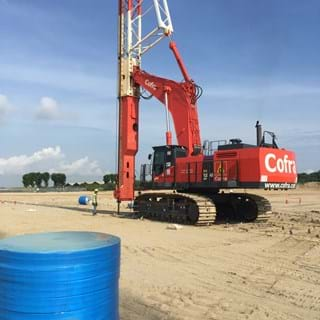
Modern installation equipment is capable of installing vertical drains to significant depths. Depending on the project conditions, Cofra can install Prefabricated Vertical Drains (PVDs) to depths of up to 60 m below ground level. Installation productivity is typically high, with daily production rates often ranging between 7,000 and 10,000 m of installed drains, depending on the ground conditions, drain spacing and site logistics.

The required installation depth is normally determined by the thickness and depth of the compressible soil layers contributing to future settlements. For this reason, the geotechnical design is generally based on ground investigation data, such as CPTs and boreholes, to identify the layers that require treatment.

A review of the available ground investigation data can also help determine the most economical installation approach. In some cases, a heavy push-force rig may be the preferred solution, while in other projects predrilling combined with lighter installation equipment may provide a more cost-effective alternative. Cofra can assist with feasibility assessments, budget estimates and installation risk evaluations during the early stages of a project.

2021 01 17 Aanleggen Biodrain Baanstee Noord 1

Do vertical drains reduce settlements?

This is a common misconception. Vertical drains do not normally reduce the ultimate primary settlement of a soil layer. Instead, they accelerate the rate at which settlement occurs by shortening the drainage path for excess pore water.

The rate of consolidation depends on several factors, including the soil properties, drain spacing, loading conditions and drainage boundaries. By selecting an appropriate drain spacing, a settlement process that would naturally take many years can often be accelerated to a matter of months. This allows a significant portion of the settlement to occur before the construction of the permanent works. As a result, post-construction settlements can be substantially reduced and the long-term performance of the development can be better controlled.

The acceptable residual settlement depends on the type of project and the performance requirements of the structure. For many infrastructure and development projects, the allowable residual settlement is often in the order of several centimetres to a few decimetres over the design life of the asset. The required level of improvement should therefore always be assessed on a project-specific basis.

COFRA090608_BELOUGA42

How much time can vertical drains save?

There is no single answer to this question, as the achievable time savings depend on the soil conditions and project requirements. Important factors include the soil permeability, drain spacing, thickness of the compressible layers, surcharge magnitude, loading duration and the required degree of consolidation.

Simple preliminary calculations can often provide a reliable first estimate of the expected consolidation period. For more accurate predictions, detailed geotechnical analyses are typically performed. These analyses may consider factors such as staged construction, submerged loading conditions, creep behaviour and the interaction between different soil layers.

In many projects, vertical drains can reduce consolidation periods from many years to several months. In some applications, particularly when combined with vacuum consolidation techniques, even greater acceleration can be achieved.

Because every project is unique, consolidation analyses are normally carried out to predict the expected construction schedule benefits and to determine the most economical ground improvement solution.

Is your question not in the list? No worries, contact our expert for an answer

Technical Sales Cofra

For design questions or technical information.

Back to the FAQ Vertical drains page